LIQUIDWAVE for Mac · Styles
A particle music visualizer, drawn in points and data.
Updated 7 October 2026
Raster is LIQUIDWAVE's style of points: tens of thousands of them, white on black, with one red accent. Out of them, the music builds a volume of linked data, a lattice, a globe, a double helix, a radar scope and a strange attractor. Helix, Radar, Attractor and Orbit are new in 1.1.
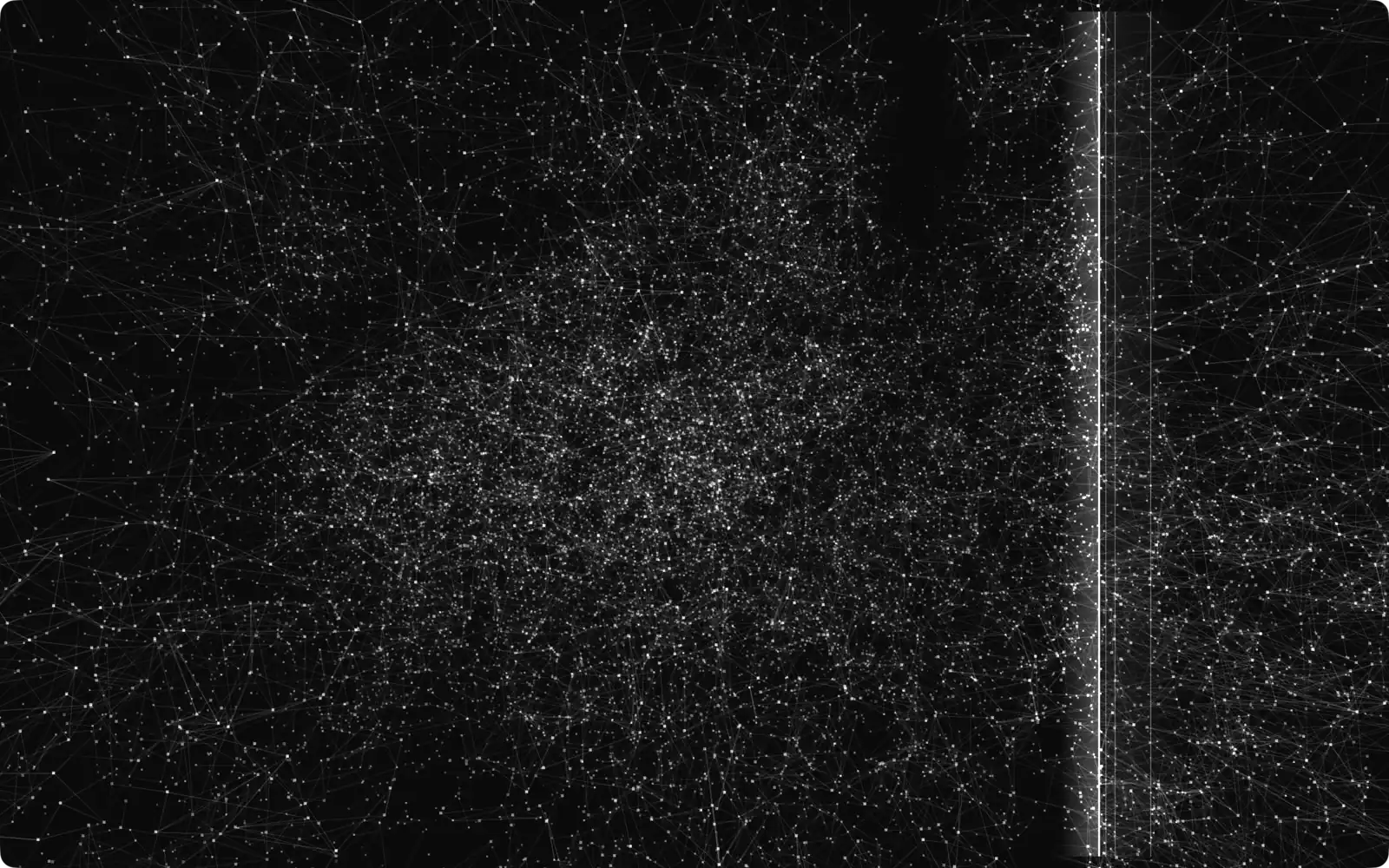
The low end moves, the top of the mix turns red
Every Raster scene speaks the same language:
- The bass moves the geometry. Each beat punches the shape in proportion to its bass, and a slow swell rises once per beat.
- The top of the mix paints the red. The hi-hats, cymbals and upper voice decide how much red there is, and how hot. A bass-only mix leaves almost none.
- The turn only goes forward. A rotating figure runs on tempo, loudness and drum hits, counters that never run back, so each hit lurches it on.
Every Raster scene
Datum. A volume of data points wired to their nearest neighbors. Every beat shoves each cluster its own way, stretching the links between them, and loudness decides how much of the cloud exists. A red line falls through it about every twenty seconds, and every thirty a white line wipes the cloud away and seats a new one, built to its own plan: broad clumps or a fine spray, wired tight or loose.
Morph. A cloud that glides between six shapes, a blob, a ring, a line, a grid, a shell and twin blobs, each point keeping its identity, with red markers riding along. It holds a shape for seven beats and changes over nine, a step per beat, faster when loud.
Voxel. Cube's twin, deforming. The same lattice, closer and without edges, twists, draws in to a ball, sharpens to an octahedron, closes to a pyramid, flattens to a floor, rolls into a tube, bends into a torus and straightens back into the cube, about a minute for the round with music.
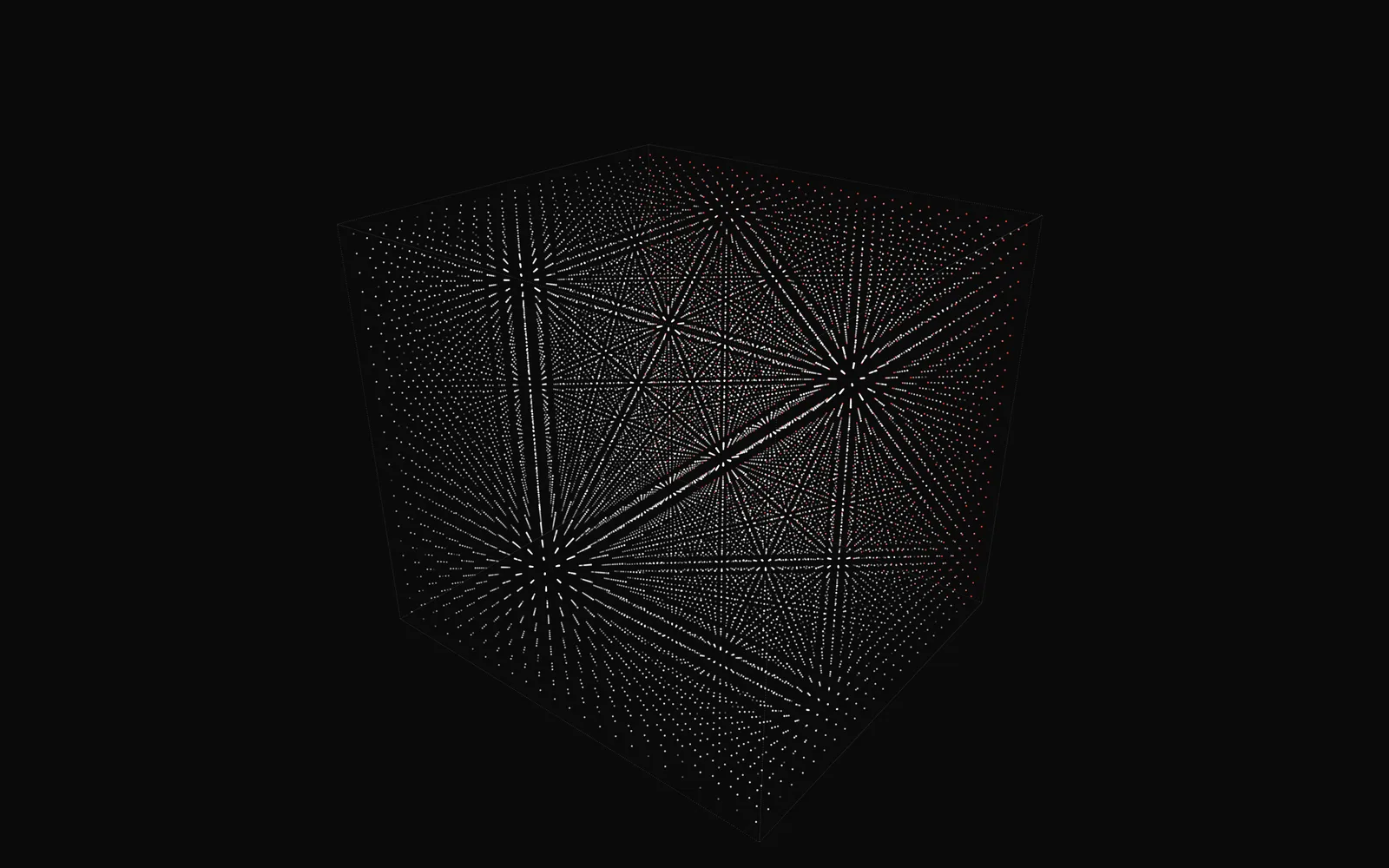
Cube. A 24 × 24 × 24 array of points turning slowly inside its own hairline edges. On a slow cycle the points scatter into a cloud, stand in columns like a forest of rods, then settle on the lattice, whose rays in perspective become the picture. Each axis breathes with a band, the kick lunges the camera, and a red plane sweeps through it.
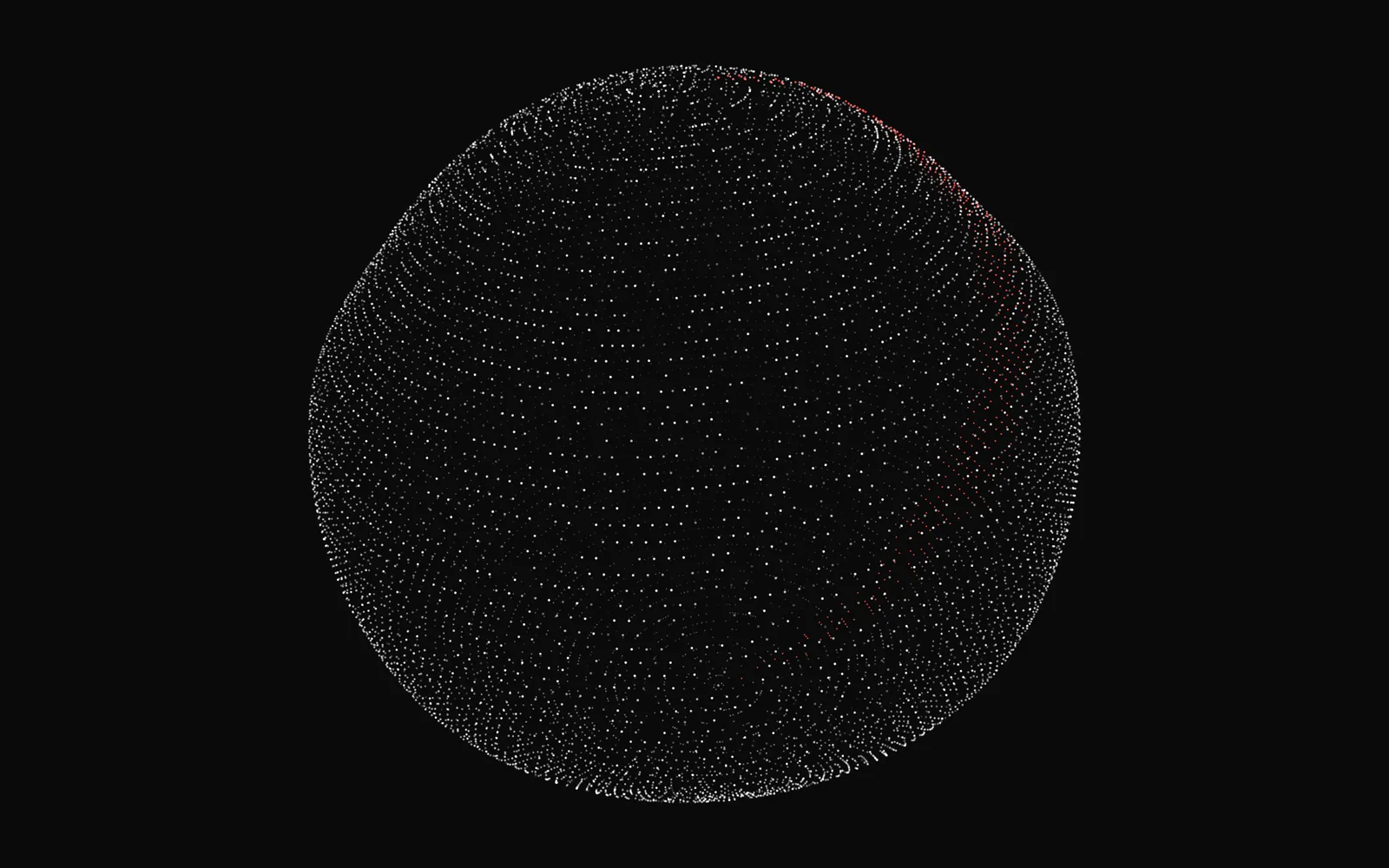
Orbit. A data globe: points on a latitude and longitude grid, most seats empty, its axis slowly precessing. The bass pushes the equator out, the mids the middle latitudes and the highs the poles. A red meridian circles it, wider when the top of the mix is busy.
Particles. Twenty thousand points condensed into one horizontal line. Each beat throws a random handful off it, and a spring pulls them home, overshooting once. A bass-heavy beat throws more of them, further. Silence leaves a still, hair-thin line.
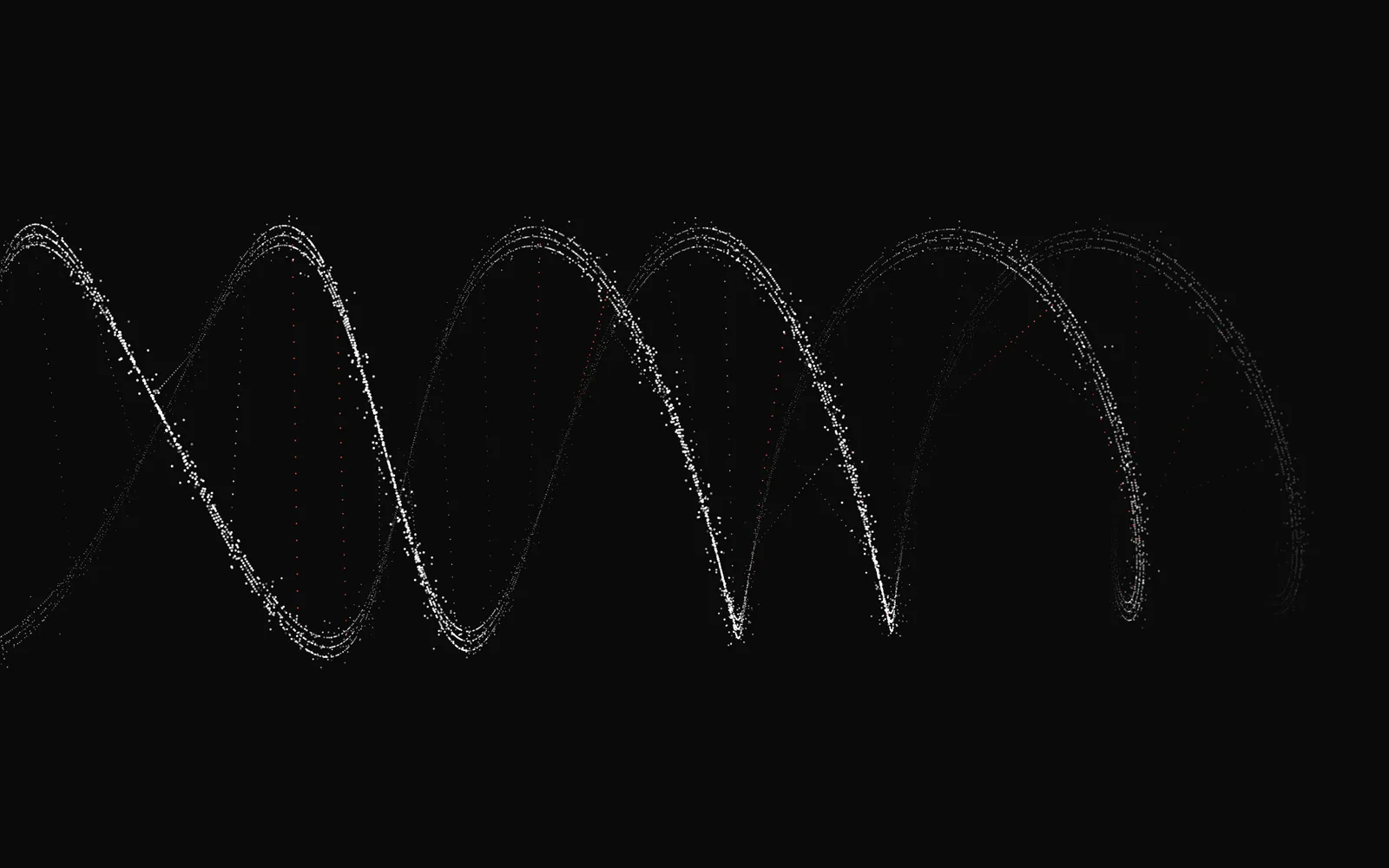
Helix. A double helix of points across the frame, turning about its own axis, dotted rungs between the strands. The last second or two of music is laid down its length and flows away into the distance: the low end swells the radius, the top of the mix frays the strands, and each kick sends a compression down the axis.
Radar. A radar scope drawn in points, its arm sweeping clockwise over dotted range rings. Behind the arm, the last second or two of music glows as a polar spectrogram, bass at the center and air at the rim, the freshest returns in red. The arm turns with loudness and surges on every hit, about a turn a bar, and each kick and snare lands as a ping and a target box.
Attractor. A strange attractor, the de Jong map, drawn as the density of its orbit: fine white points crowding into bright filaments and folded sheets, turning slowly in depth. It travels through eight figures, a dense crescent, a knot of loops, a single hairline and a hook among them, gliding on a step per hit. Every hit sends a ripple through it, and a red thread widens with the upper mids and the snare.
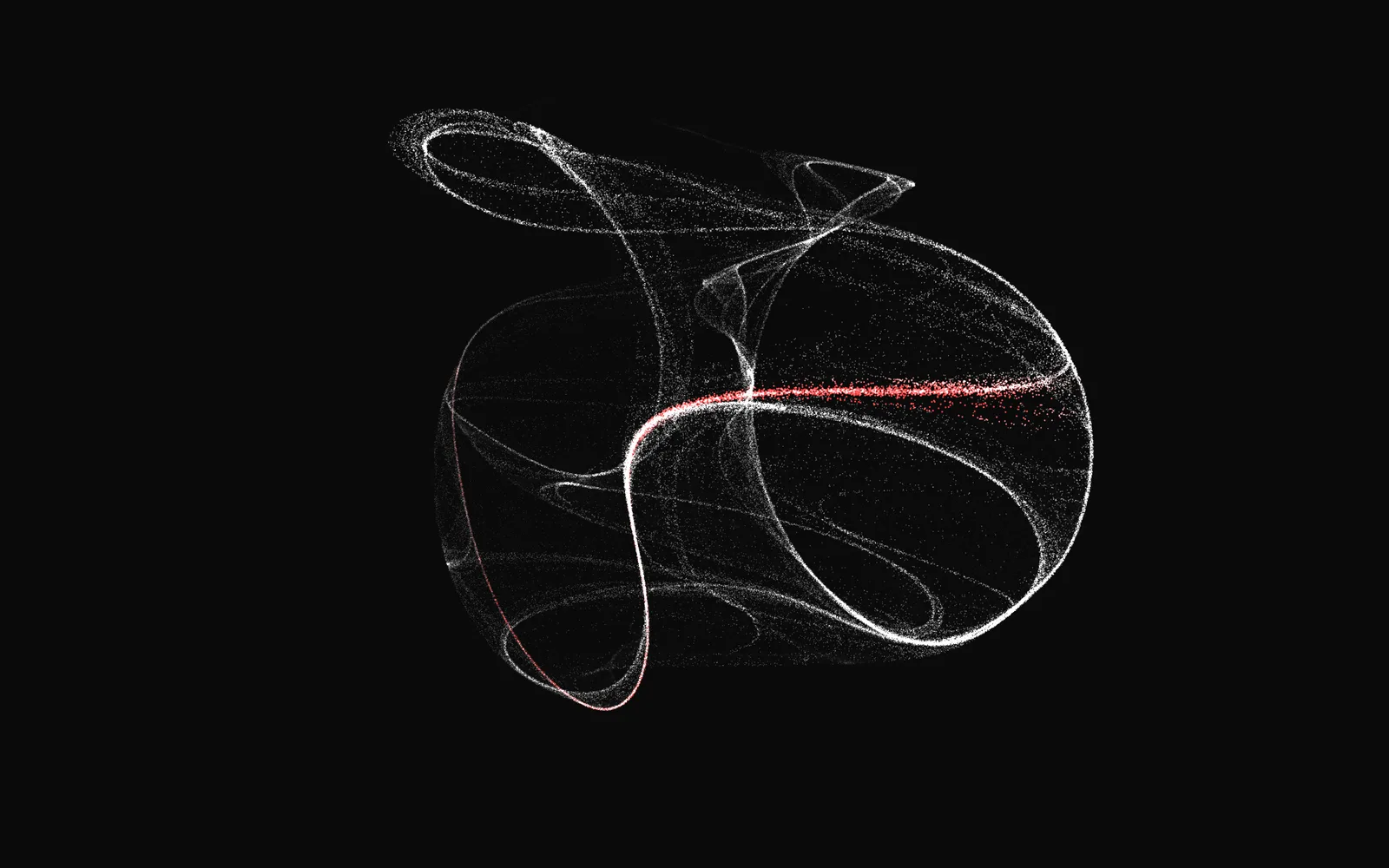
On a Mac, a click on the picture acts as a touch: Attractor parts its points around it, Radar drops a contact there, and Helix pushes its points aside.
How Raster plays with different music
A steady four-on-the-floor gives Raster its pulse: Datum lurches on every kick and Particles blooms on every beat. When the music stops, Morph and Voxel glide on slowly, while Radar, Attractor, Helix and Particles come to rest.
What to expect
Shapes change over bars, not on every beat. In Morph, Voxel and Attractor the kick barely stirs the body; the change of shape is the show. For light that flares on the drums, try Lighting.
It is monochrome. Apart from the red, Raster is white on black. Chroma fills the frame with color instead.
Silence means stillness. If Radar shows only its rings, LIQUIDWAVE isn't hearing anything. System Audio explains how it listens to your Mac.
Where to go next
Wire draws the music in 3D wireframes, and Spectral, also new in 1.1, reads it pitch by pitch. Every style is on the styles page. LIQUIDWAVE for Mac is a free download with two scenes, Wave and one you pick, and one purchase inside the app unlocks the rest of the 60+ scenes, every Raster scene included.
macOS 14.2 or later · notarized by Apple · free
Questions
- Which scenes are in the Raster style?
- Datum, Morph, Voxel, Cube, Orbit, Particles, Helix, Radar and Attractor. Helix, Radar, Attractor and Orbit are new in LIQUIDWAVE 1.1.
- Why do some points turn red?
- The red follows the upper mids and highs: hi-hats, cymbals and the top of a voice. A bright mix brings in the red planes, meridians and threads, and a bass-only passage leaves the Raster scenes almost entirely white.
- Why is Radar standing still?
- Its arm turns only with loudness and drum hits, so in silence it holds still over its rings. If music is playing and the arm doesn't move, LIQUIDWAVE isn't hearing your Mac: allow it under Screen & System Audio Recording in System Settings → Privacy & Security, then press Retry on the lock badge in the window's corner.
- Is the Raster style in the free version?
- The download is free and includes two scenes, Wave and one you pick, with no time limit. One purchase inside the app unlocks the rest, every Raster scene included.