LIQUIDWAVE for Mac · Styles
An audio spectrum visualizer, drawn pitch by pitch.
Updated 7 October 2026
Spectral is a style of hairlines and fine points, new in LIQUIDWAVE 1.1. It is an audio spectrum visualizer in the plain sense: every scene is drawn from a fine spectrum of the sound, so a held note lights a line of its own, a chord lights several, and the kick, the snare and the hats each do something different.
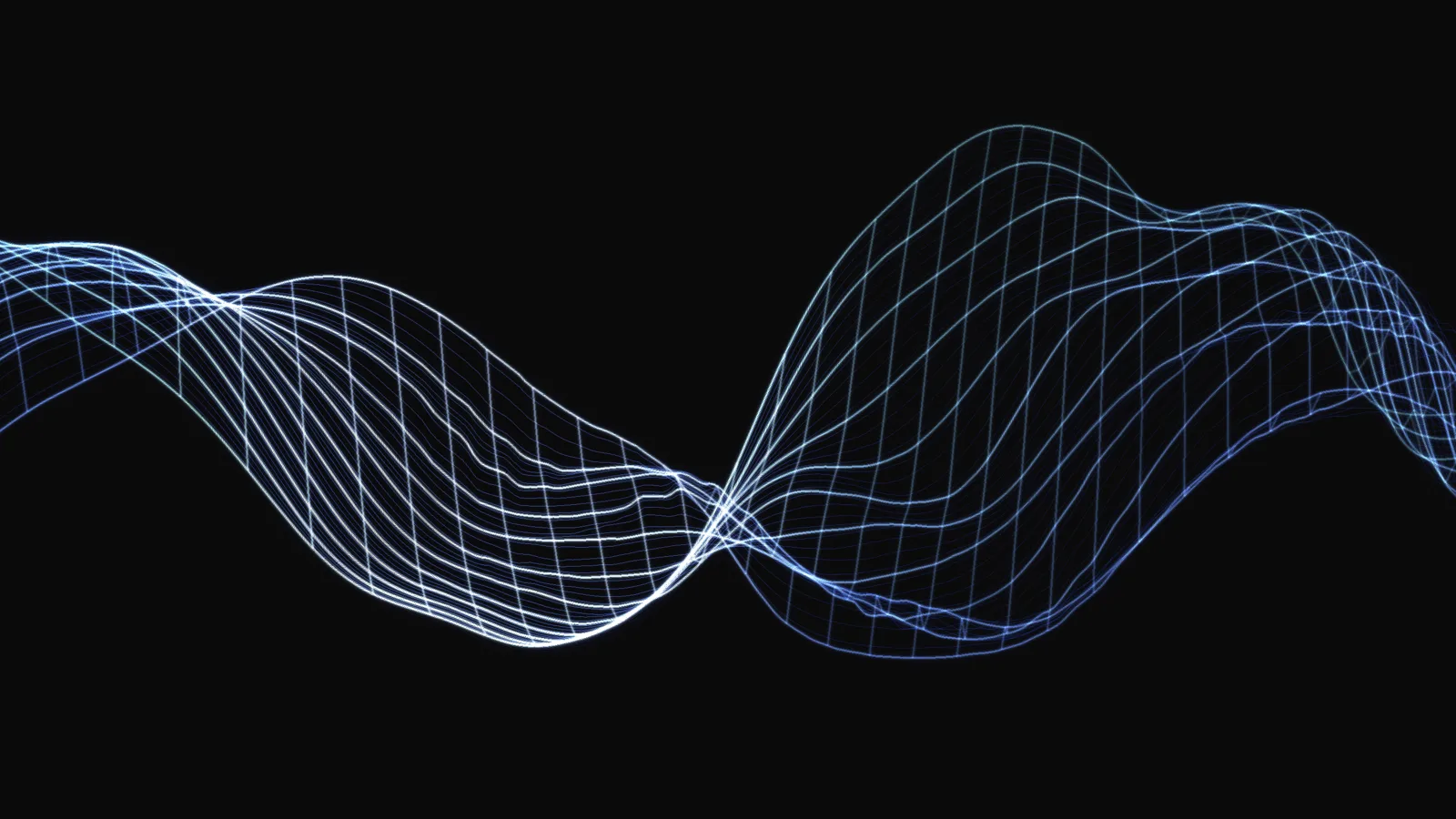
Drawn from a finer spectrum
The rest of LIQUIDWAVE reads the music as seven bands, from sub-bass to air. Seven bands can tell a bass line from a hi-hat, but not one note from the next. The Spectral scenes read 64 bands, spaced by pitch from 40 Hz to 16 kHz, fine enough that a single tone lands on a band of its own.
The renderer also keeps the last four seconds or so of that spectrum, 60 columns a second on any display. That history lets a scene draw time: echoes that keep the shape they were drawn with, waves as long as the last few seconds, grains that hold the pitch they were born at.
Motion runs on clocks that only go forward, so nothing jumps back on a beat. Nothing flashes the whole frame either: the light is in the lines.
Every Spectral scene
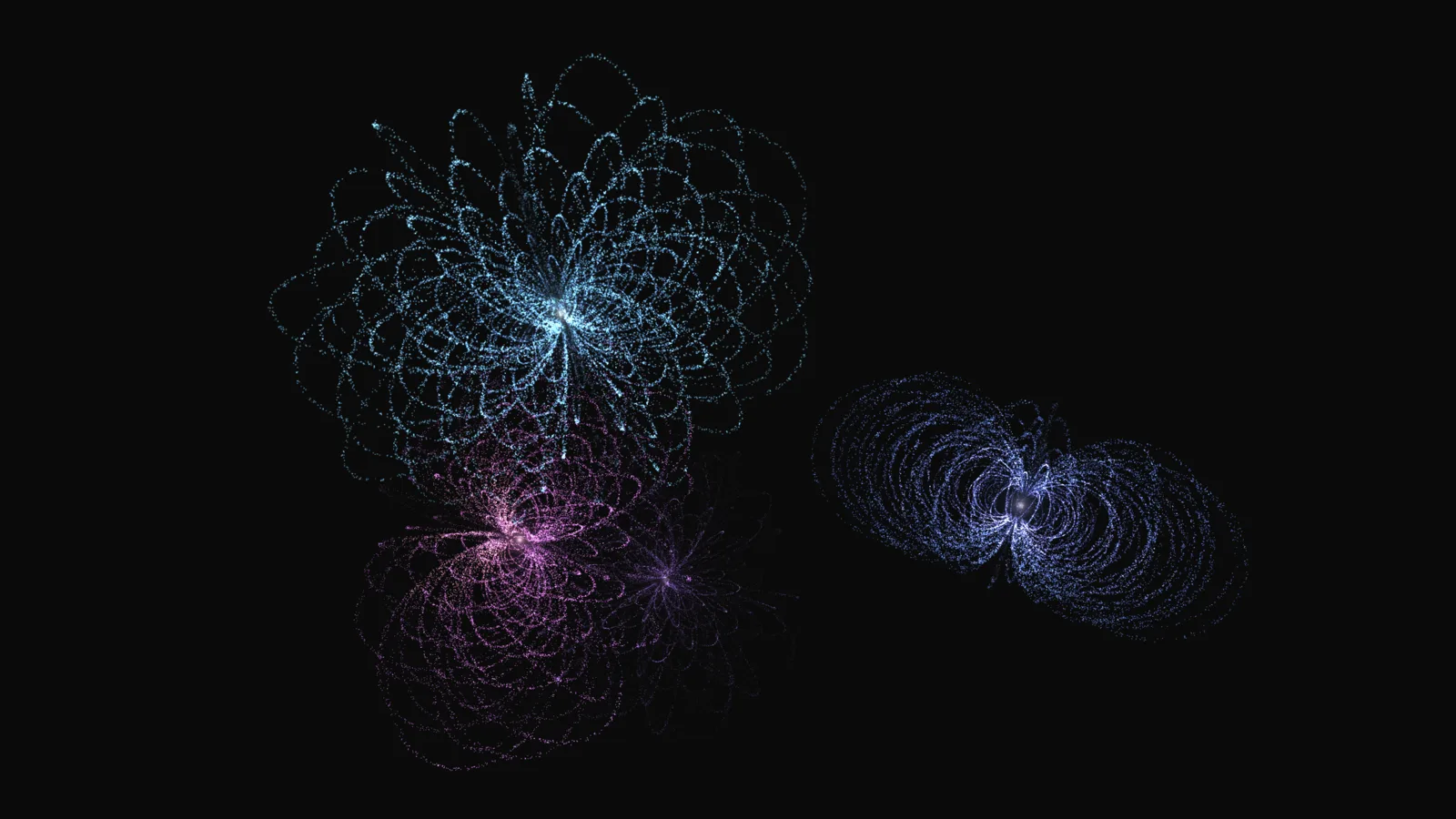
Dipole. Four magnets drift through deep space, thousands of glints streaming along their field lines. Each nested shell of loops is a pitch, so a note's attack leaves the pole as a packet of light and runs round its loop. The kick sends the nearest magnet lunging toward you, and the hats glint single points.
Feedback. A circular scope in hairlines, three rings deep for the low, middle and top registers, with dozens of its own echoes streaming out of the depth behind it, each older one nearer, wider, turned and shifted in hue. It is the old desktop visualizers' feedback trick, done without a buffer. The kick throws every echo drawn before it nearer, and the snare twists them.
Lathe. A glowing vessel turned on a lathe, drawn in hairline rings like spun glass. Its profile is the spectrum, pitch running from foot to lip, so a bass note fattens the foot and the hats flare the lip, with fainter shells of the shape a moment ago around it.
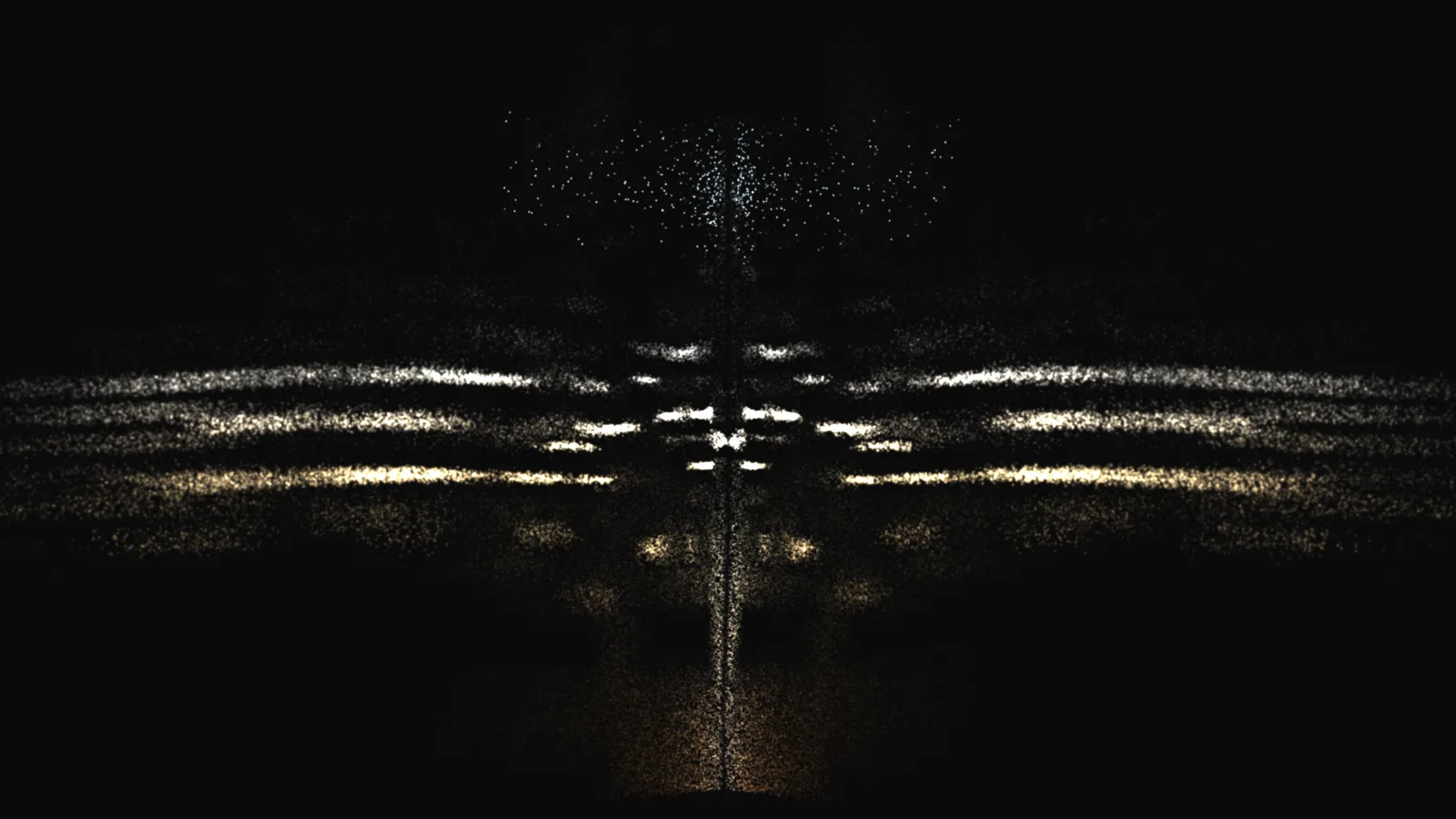
Granular. A pointillist spectrogram. Grains of light are born on a seam down the middle at the pitch and moment they sounded, amber low and icy cyan high, and drift to either side as they fade. Held tones leave lasting threads, noise a fine dust, and a snare sprays a burst from the middle.
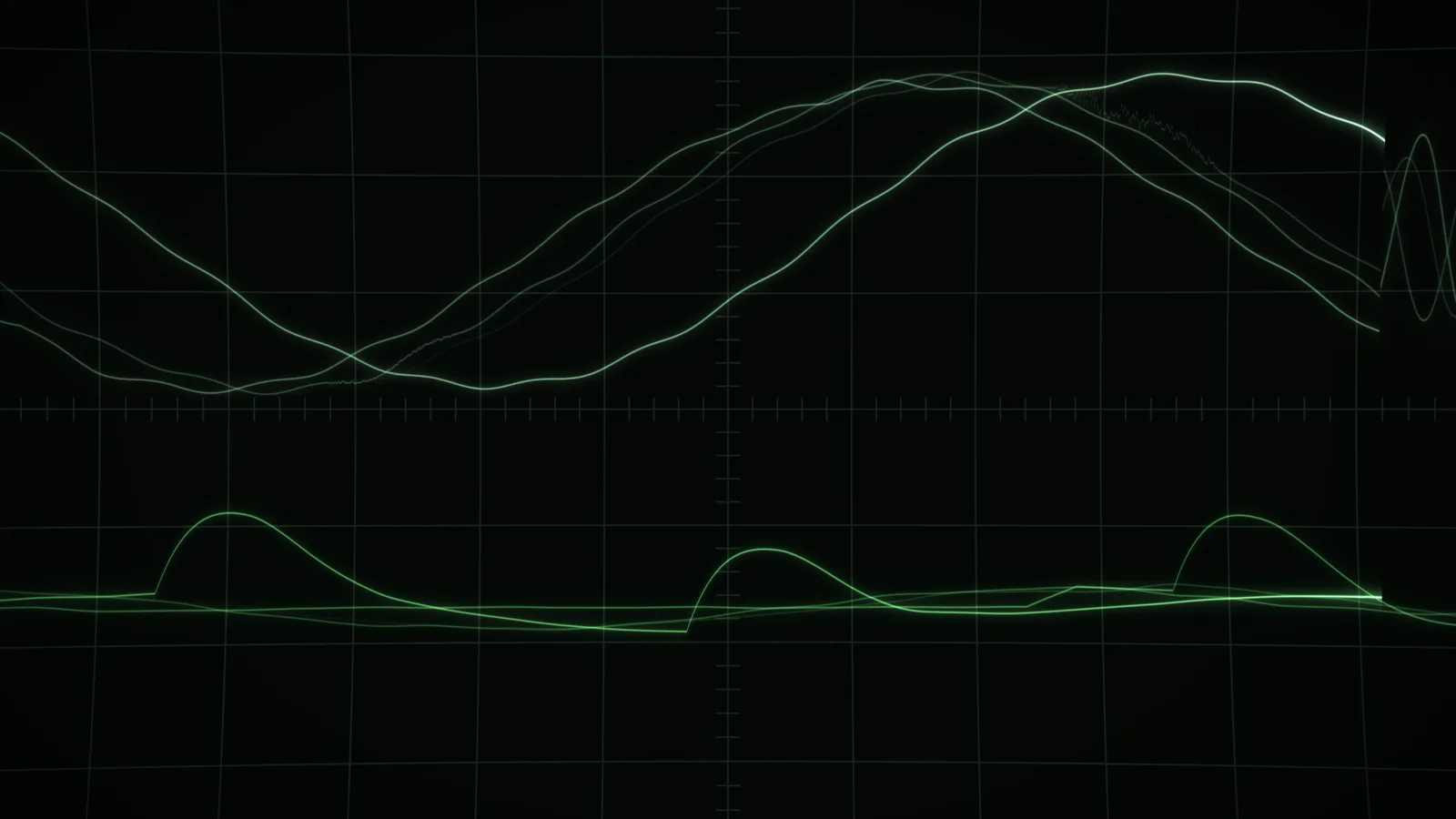
Scope. A two-channel oscilloscope on a green-phosphor tube with a free-running sweep, so the last few passes still glow and drift across each other. The upper trace is the music's waveform built from the spectrum, a bass note one long wave and the notes above it finer ripples. The lower trace wobbles with the low end, and every kick leaves a blip on it where the beam was.
Signal. Four waveforms run into the dark over a circuit-board floor, lime in front and teal at the back, each a register of the music, so every note and hit stands up as a packet and travels away. The kick sends a pulse of light along the floor's traces.
Warp. A dozen blue strands tied into a net that twists through space, white where it turns edge-on, each strand a register. A quiet passage relaxes it to near-straight lines, a heavy low end rolls long waves across the frame, and busy mids and highs chop it short, so it changes over bars rather than on every beat.
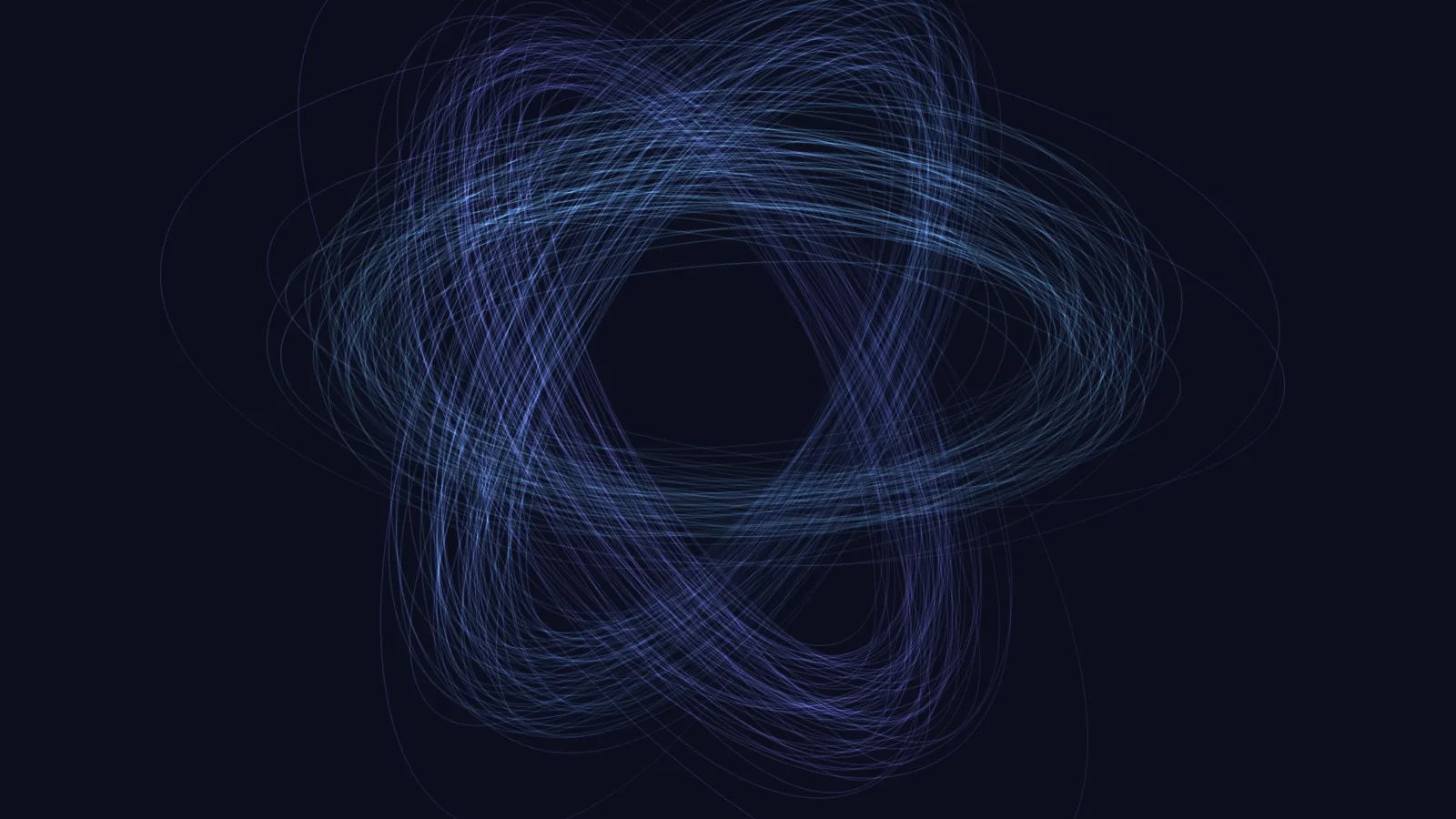
Atom. The style closes on a homage to a classic record sleeve: three sheaves of fine neon ellipses about one center, in cyan, azure and violet-blue. Every orbit is a pitch. The figure holds still and the music moves the orbits inside it: a note swells its orbits out of their sheaf, a kick ripples through the low ones, and the hats flare electrons running round them.
Click the picture and each scene answers in its own way: Scope's nearer trace is pulled toward the pointer like a position knob, and Lathe draws its form out at that height.
What to expect
They want music playing. The Spectral scenes answer silence with stillness. Granular fades to black within four seconds, Scope settles to two flat, dim lines, Lathe to a slim spindle, Feedback to one dim ring, and the others dim and all but stop. A paused player leaves the screen near dark, and a quiet passage draws less than a loud one. With no source running, Ambient Auto plays them from a score of its own.
It is not a meter. The spectrum is shaped for the eye, tilted so pink noise reads flat and scaled by the Intensity slider, with no axes and no decibel readout. To check a mix, use an analyzer built for measuring.
Where to go next
Fluid, the other new style in 1.1, moves liquids with the music. Every style is on the styles page. LIQUIDWAVE for Mac is a free download with two scenes, Wave and one you pick, and one purchase inside the app unlocks the rest of the 60+ scenes, every Spectral scene included.
macOS 14.2 or later · notarized by Apple · free
Questions
- Which scenes are in the Spectral style?
- Dipole, Feedback, Lathe, Granular, Scope, Signal, Warp and Atom, all new in LIQUIDWAVE 1.1 for Mac.
- How is Spectral different from the other styles?
- The other styles read the music as seven bands. The Spectral scenes read 64 bands spaced by pitch from 40 Hz to 16 kHz, with about four seconds of history, so they can answer single notes and draw the last few seconds of the music.
- Why is a Spectral scene nearly dark?
- They come to rest in silence. A running source that hears nothing, System Audio with the player paused or Listen Mode in a quiet room, keeps them dim and still. Start the music and they come back; with no source running, Ambient Auto plays them from a score of its own.
- Can I use it as a spectrum analyzer?
- Not for measuring. The spectrum is tilted so pink noise reads flat, eased and scaled by the Intensity slider, and there are no axes or decibel readouts. It is made for watching music, not for checking a mix.
- Is the Spectral style in the free version?
- The download is free and includes two scenes, Wave and one you pick, with no time limit. One purchase inside the app unlocks the rest, every Spectral scene included.